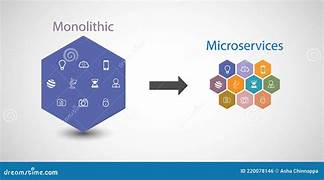
Converting Monolith to Microservices
Complete migration guide for professional developers
Quick Summary (30 seconds):
Convert incrementally using the Strangler Fig Pattern. Never do big bang migration. Start with identifying bounded contexts, extract one service at a time, use anti-corruption layer, and gradually redirect traffic. The goal is zero downtime throughout migration.
Convert incrementally using the Strangler Fig Pattern. Never do big bang migration. Start with identifying bounded contexts, extract one service at a time, use anti-corruption layer, and gradually redirect traffic. The goal is zero downtime throughout migration.
Phase 1: Assessment and Planning
Duration: Weeks 1-4
1
Identify Bounded Contexts (DDD)
Look for:
Look for:
- Naturally isolated business capabilities
- Teams already organized around functions
- Database tables with clear ownership
- Low cross-domain transaction frequency
2
Score Candidates for Extraction
Criteria:
Criteria:
- Business value (high = extract early)
- Technical complexity (low = extract early)
- Independence from monolith (high = extract early)
- Team ownership (clear = extract early)
3
Understand Dependencies
Tools:
Tools:
- Code analysis: JDepend, SonarQube
- Runtime tracing: Distributed tracing tools
- Database foreign key analysis
- Team interviews for hidden dependencies
Phase 2: Strangler Fig Pattern Implementation
Step 1: Add Proxy Layer
// Route traffic through API Gateway
// /payments/* -> Payment Service
// /* -> Monolith (gradually migrate)
Step 2: Anti-Corruption Layer (ACL)
// Anti-Corruption Layer - Protects monolith from service changes
class PaymentAntiCorruptionLayer {

    function processPayment(monolithRequest) {
        // Transform from monolith model to service model
        serviceRequest = transformer.toServiceModel(monolithRequest);

        // Call service
        serviceResponse = paymentClient.process(serviceRequest);

        // Transform back to monolith model
        return transformer.toMonolithModel(serviceResponse);
    }

    // Fallback when service is down
    function fallbackPayment(monolithRequest) {
        return new PaymentResponse("PENDING", "Payment queued for processing");
    }
}
Phase 3: Data Migration Strategy
Dual Write Pattern
// Phase 1: Dual Write (Write to both)
function createOrder(request) {
    // Write to monolith database (legacy)
    order = monolithOrderRepository.save(createOrder(request));

    // Also write to new service via API
    asyncCall(() => {
        orderServiceClient.createOrder(order);
    });
    return order;
}

// Phase 2: Backfill Historical Data
function backfillHistoricalData() {
    oldOrders = monolithOrderRepository.findNotMigrated();
    for (order in oldOrders) {
        try {
            orderServiceClient.createOrder(order);
            order.setMigrated(true);
            monolithOrderRepository.save(order);
        } catch(error) {
            log.error("Failed to migrate order", order.id);
        }
    }
}

// Phase 3: Switch to New Service as Source of Truth
function createOrder(request) {
    // Write only to new service
    response = orderServiceClient.createOrder(request);
    return convert(response);
}
Example: E-Commerce Migration
Before - Monolith Structure
// MONOLITH: Single application with all features
class ECommerceMonolith {
    // Contains: Order, Payment, Inventory, Shipping, User, Review
}

// Single database with all tables
// orders, payments, inventory, shipments, users, reviews

// Tightly coupled code
class OrderService {

    function createOrder(request) {
        // All in one transaction
        inventoryService.reserveStock(request.getItem());
        paymentService.processPayment(request.getItem());
        order = orderRepository.save(createOrder(request));
        shippingService.createShipment(order);
        return order;
    }
}
After - Step 1: Extract Payment Service
// NEW PAYMENT SERVICE (Independent Microservice)
class PaymentServiceApplication {
    // Own database: payment_db
}

class PaymentController {
    function process(request) {
        return paymentService.process(request);
    }
}

// MODIFIED MONOLITH - Call Payment Service via HTTP
class OrderService {
    private paymentClient;

    function createOrder(request) {
        // Call Payment Service via API
        payment = paymentClient.process(request.getPayment());

        // Still in monolith
        inventoryService.reserveStock(request.getItems());
        order = orderRepository.save(createOrder(request));
        shippingService.createShipment(order);
        return order;
    }
}
Common Pitfalls and Solutions
Problem: Distributed Transactions
Symptom: Data inconsistency across services
Solution: Use Saga pattern with compensating transactions
Symptom: Data inconsistency across services
Solution: Use Saga pattern with compensating transactions
Problem: Shared Database
Symptom: Tight coupling continues
Solution: Database per service + event-driven sync
Symptom: Tight coupling continues
Solution: Database per service + event-driven sync
Problem: Chatty APIs
Symptom: Too many network calls
Solution: API composition + GraphQL/BFF
Symptom: Too many network calls
Solution: API composition + GraphQL/BFF
Solution: Fallback Failures
Use Circuit Breaker + Timeout + Retry to prevent cascade failures
Use Circuit Breaker + Timeout + Retry to prevent cascade failures
Solution: Migration Never Ends
Set hard deadline, incentivize completion
Set hard deadline, incentivize completion
Migration Checklist
| Phase | Key Activities | Success Criteria |
|---|---|---|
| Assessment | Identify bounded contexts, score candidates | Priority list of services to extract |
| Proxy Layer | Add API Gateway, route traffic | Zero downtime routing |
| Extract Service | Create new microservice, dual write | Service handles 100% traffic |
| Data Migration | Backfill data, switch source of truth | Legacy writes stopped |
| Decommission | Remove old code, shutdown monolith part | Monolith shrunk |
Expert Insight:
"The Strangler Fig Pattern isn't just about technical migration - it's about business continuity. Each extracted service must provide value independently, so stakeholders see progress. The Anti-Corruption Layer is your most important safety net. Database migration is harder than code migration - use the Dual Write pattern."
"The Strangler Fig Pattern isn't just about technical migration - it's about business continuity. Each extracted service must provide value independently, so stakeholders see progress. The Anti-Corruption Layer is your most important safety net. Database migration is harder than code migration - use the Dual Write pattern."
Key Takeaways
- Never do big bang migration - incremental is the only safe way
- Strangler Fig Pattern is the industry standard approach
- Anti-Corruption Layer protects your system during transition
- Dual Write pattern ensures zero data loss
- Set deadlines - without them, migration never completes
- Extract high-value, low-complexity services first
Final Advice:
"Start with a monolith. Seriously. Extract services only when you have proven need - different scaling requirements, different teams, or different tech stacks. The goal isn't microservices; the goal is business agility."
"Start with a monolith. Seriously. Extract services only when you have proven need - different scaling requirements, different teams, or different tech stacks. The goal isn't microservices; the goal is business agility."